2018 United Kingdom National Pilgrimage Tour Itinerary
http://www.relicourladyofguadalupe.co.uk
The purpose of the distribution of these Sacred Images is to help fulfil the prophecy of Saint John Paul II when visiting Guadalupe in 1979.
His exhortation proclaimed: “The Basilica of Our Lady of Guadalupe will be the center from which the light of the gospel of Christ will illuminate the entire world by the means of distribution of the Miraculous Image of His mother.”Saint John Paul II authorized the creation of 220 digital replicas of the original for worldwide distribution. These Images have been declared as Authorized Relics that will extend the graces of evangelization, conversion & truth to nations in which they're placed, offering the same graces as extended in 1531, equal in graces to that of the original first class Relic




Signs & Symbols
SYMBOLS ON THE SACRED TILMA & THEIR SIGNIFICANCE IN AZTEC THOUGHT
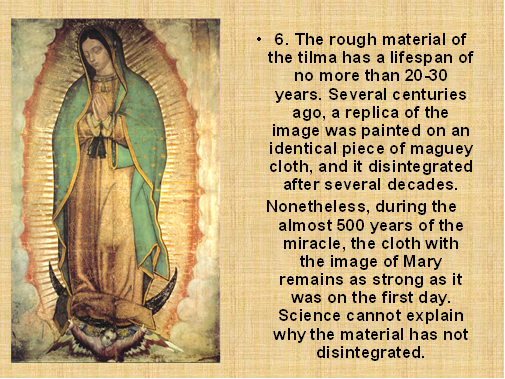
 SUN’S RAYS
The rays give the
sacred image an aura of light. They appear as though they're emitted
from her, based on the direction of the arrows & the wavy pattern –
indicating that she’s giving birth to the sun. Since the
Aztecs worshipped the sun as the god that gives them life, the image
portrays the Virgin Mary as giving birth to god.
This is further
reinforced by the 4-petalled flower on Our Lady’s womb as described
below. The Aztecs called their sun god Huitzilopochtli (their god of
war, too) & to appease him, they offered palpitating human hearts
which they considered to be a symbol of life. They also believed in Ometéotl, a god with 2 natures.
 FOUR-PETALLED FLOWER
The Aztecs closely
observed the movement of the sun, moon, & stars, & based their
religious beliefs & way of life on these. They were deep into
cosmogony – that branch of science dealing with the origin of the
universe, particularly the solar system.
The 4-petalled
flower is the only flower of its kind found on Our Lady’s robe. It is
considered to be one of the highest symbols of the Aztecs as it depicts
the 4 movements of the sun (the 4 seasons) as well as the North,
South, East & West united in the center by a 5th element giving it
balance & equilibrium.
The 4 petals also signify the 4 past eras
with its center signifying the birth of the Fifth Sun which coincided
with the Winter Solstice of 1531 – Our Lady’s miracle of 12 December.
The location of the
4 petalled flower is known to the Aztecs as Nahui Ollin representing
the motherhood of Our Lady. With its strategic location, Our Lady’s
Image tells the Aztecs she is the Mother of the ‘sun god’ that’s in her
womb – the author & giver of life.
 HER FACE
Our Blessed Mother’s
face is bowed down, looking at everyone tenderly & with compassion.
She is gazing slightly to one side as a sign of reverence & respect as
native Indians considered it improper to look directly at anyone’s
face.
The face of Our Lady is
that of a young girl who is considered mestizo, meaning a blend of
races – in this case, Aztec & Spanish. This was the term used by the
Spaniards to identify the children of Spanish conquistadores & Aztec
women. The portrayal of the Blessed Virgin Mary on her Image as mestizo
symbolized the birth of a new race.
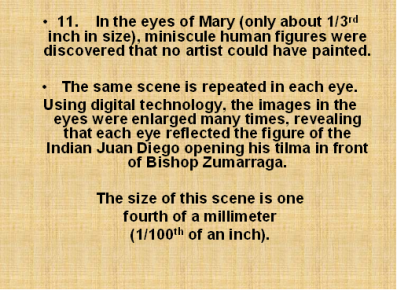
 HER EYES
Looking closely into
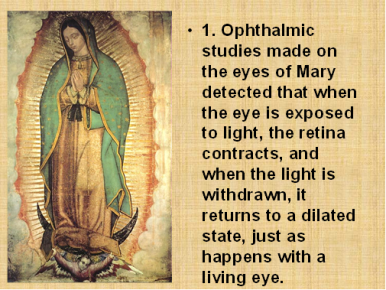
Our Lady’s eyes, ophthalmologists have tested this sacred image &
affirmed that there are human forms reflected in her eyes, which measure
between 8-9mm. It would be impossible to paint this detail within such a
tiny space & on such rough material.
Further examination by a Dr Jose
Aste Tonsman revealed 13 persons reflected in her eyes. Magnified
photos show the larger images as reflections of Juan Diego & Bishop
Juan de Zumarraga. The rest could be images of those present when Juan
Diego opened his tilma to show the Bishop the sign he had asked for.
 HER HAIR
On the Sacred Image,
our Blessed Mother’s hair is loose, indicating she’s a virgin maiden –
married indigenous women braided their hair.

BLACK RIBBON
This signifies that she
is a noblewoman with child – noble indigenous women tied a black ribbon
just above their waist to show they were pregnant. This symbol,
together with the symbolism of Our Lady’s hair, confirms her message to
St Juan Diego – ‘I am the Always Holy Virgin Mary, Mother of the true
God.’
Her hands are joined
together in prayer, just as Europeans do, confirming her request that
the Bishop build a chapel (a house of prayer) on Tepeyac Hill where she
appeared. The Blessed Virgin’s hands show her right hand as being more
delicate & lighter in colour than the left which is fuller & darker –
depicting her message for unity of the Indian & Spanish cultures and
the birth of a new race.
Her beautiful turquoise
mantle covers her whole body from her head down to her feet & is
edged in gold. The indigenous people considered her an Empress since
only their Emperor wore this color. Her mantle is covered with 46
eight-pointed stars which are believed to be the stars that were in the
heavens during the winter solstice of 1531.
Video about the miraculous image of Our Lady of Guadalupe:
Another video (awesome): (re-enacted) Our Lady Of Guadalupe:
And another (short):
Scientific documentary on it (in English):
https://www.youtube.com/watch?v=Q7Wcl7xY5fA


