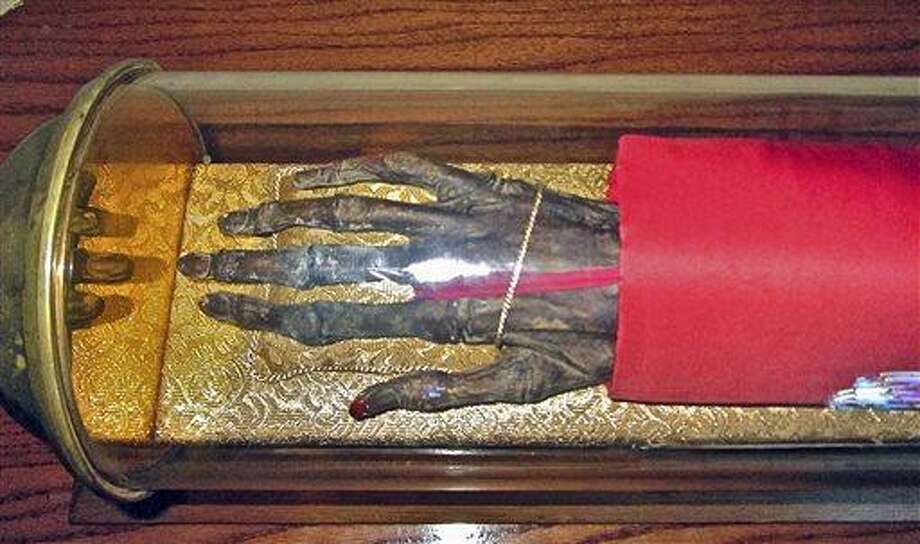
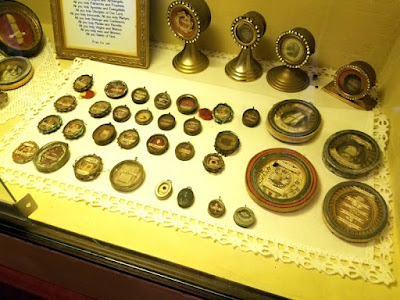
Vatican releases new instruction on saint relics
Relics
must be certified as authentic before being exposed for veneration
Jan 4, 2018
By Carol Glatz
Catholic News Service
VATICAN CITY (CNS) -- Only relics
that have been certified as authentic can be exposed for veneration by faithful,
said a new Vatican instruction.
Published Dec. 16 in Italian by Congregation
for Saints' Causes, instruction clarifies & details canonical procedures to
be followed by local bishops in an effort to verify authenticity of relics
& mortal remains of saints & blesseds, as well as better guarantee a
relic's preservation, approve & track its movements, & promote its
veneration.
The instruction replaces appendix,
"Canonical Recognition of Mortal Remains of Servant of God," included
with "Sanctorum Mater," congregation's "Instruction for
Conducting Diocesan or Eparchal Inquiries in Causes of Saints," released
in 2007.
The new instruction outlined specific
procedures & personnel necessary for canonical recognition of authenticity
of relics or remains of a saint or anyone on path to sainthood. It also
specified that any action taken regarding relics or remains must also conform
with local government laws & have consent of saints' congregation & person
recognized as deceased's "heir."
In case of an upcoming canonization
or beatification, some small pieces or fragments already separated from body
can be removed & later given to postulator or vice postulator for placement
in a properly sealed reliquary, instruction said.
But "the dismemberment of body
is not allowed" unless bishop has obtained permission from saints'
congregation, it said.
The sale or trade of relics remains
"absolutely prohibited" as well as exposing them in
"profane" or unauthorized locations, it said.
Some of rules also include:
-- Rigorously avoiding any sign of
veneration for remains of a servant of God or venerable before beatification.
-- Obtaining written consent from congregation
& every bishop or proprietor that would be involved in moving of, in
transferring ownership of, or in pilgrimage of any relics & mortal remains
of saints & blesseds.
-- Getting consent of saints'
congregation, relevant patriarch & his permanent synod for alienation or
transfer of ownership of relics & precious icons of Eastern churches.
Congregation for Causes of Saints (on Holy See’s Website):
INSTRUCTION
"RELICS IN CHURCH: AUTHENTICITY & PRESERVATION"
http://www.vatican.va/roman_curia/congregations/csaints/documents/rc_con_csaints_doc_20171208_istruzione-reliquie_en.html
Rome 2017
INDEX
INTRODUCTION
PART
I: Request of Consent of Congregation for Causes of Saints (Artt. 1-5)
PART
II: Diocesan or Eparchial Phase of possible specific procedures to perform
Title
I. Initial Acts (Artt. 6-12)
Title
II. Specific Procedures
Chapter
I. Canonical Recognition (Artt. 13-20)
Chapter
II. Extraction of Fragments & Creation of Relics (Artt. 21-25)
Chapter
III. Translation of Urn & Alienation of Relics (Artt. 26-27)
Title
III. Final Acts (Artt. 28-30)
PART
III. Pilgrimage of Relics (Artt. 31-38)
CONCLUSION
INTRODUCTION
Relics in Church
have always received particular veneration & attention because body of Blesseds
& of Saints, destined for resurrection, has been on earth living temple of Holy
Spirit & instrument of their holiness, recognized by Apostolic See through
beatification & canonization.[1] Relics of Blesseds & of Saints may
not be displayed for veneration of faithful without a proper certificate of ecclesiastical
authority who guarantees their authenticity.
The body of Blesseds
& of Saints or notable parts of bodies themselves or sum total of ashes
obtained by their cremation are traditionally considered significant relics.
Diocesan Bishops, Eparchs, those equivalent to them in law & Congregation
for Causes of Saints reserve for these relics a special care & vigilance in
order to assure their preservation & veneration & to avoid abuses. They
are, therefore, preserved in properly sealed urns & are kept in places that
guarantee their safety, respect their sacredness & encourage their cult.
Little
fragments of body of Blesseds & of Saints as well as objects that have come
in direct contact with their person are considered non-significant relics.
If possible, they must be preserved in sealed cases. They are, however,
preserved & honored with a religious spirit, avoiding every type of
superstition & illicit trade.
A similar
discipline is applied also to mortal remains (exuviae) of Servants
of God & Venerables, whose Causes of beatification & canonization are
in progress.
Until they’re
elevated to honors of altars through beatification or canonization, their
mortal remains may not enjoy any public cult nor those privileges which are
reserved only to body of someone who has been beatified or canonized.
The present Instruction
substitutes Appendix of Instruction Sanctorum
Mater[2] & is directed to diocesan Bishops,
Eparchs & those who are equivalent to them in law, as well as to those who
participate in procedures regarding relics of Blesseds & Saints & mortal
remains of Servants of God & Venerables, in order to facilitate application
of what is required in such a particular matter.
In this Instruction
is presented canonical procedure to follow in order to verify authenticity of
relics & mortal remains, to guarantee their preservation & to promote veneration
of relics through possible specific procedures: canonical recognition,
extraction of fragments & creation of relics, translation of urn & alienation
of relics.
Furthermore, requirements
for obtaining consent of Congregation for Causes of Saints to perform such
procedures & procedure to follow for pilgrimage of relics are laid out.
PART
I
Request of Consent
of Congregation for Causes of Saints
Article 1
The one
competent to perform all possible procedures on relics or on mortal remains is Bishop
of diocese or of eparchy where they’re preserved, if he has obtained beforehand
consent of Congregation for Causes of Saints.
Article 2
§ 1. Before
undertaking any operation on relics or on mortal remains all that is prescribed
by local civil law must be observed &, in conformity with such law, consent
of heir must be obtained.
§ 2. Before beatification
of a Venerable Servant of God, heir is to be invited by competent Bishop to
donate mortal remains to Church by means of an instrument that is juridically
recognized by civil & ecclesiastical authorities, so that their preservation
may be safeguarded.
Article 3
§ 1. Competent
Bishop is to send to Prefect of Congregation for Causes of Saints written
request with which he asks consent of Dicastery for procedures which he intends
to perform.
§ 2. In this
request Bishop is to specify exact place where relics or mortal remains are
preserved (city, name of church, chapel, public or private cemetery, etc.)
& to confirm that prescription of Art. 2 § 1 of present Instruction has
already been fulfilled.
Article 4
§ 1. If Bishop
intends to perform translation (that is, permanent transfer) within confines of
same diocese or eparchy, he is to specify to Congregation place of new location
of relics or of mortal remains (city, name of church, chapel, public or private
cemetery, etc.), & include project.
§ 2. In case
of translation to another diocese or eparchy, Bishop is to send to Congregation,
together with project of new location of relics or of mortal remains (city,
name of church, chapel, public or private cemetery, etc.), written consent of Bishop
who’ll receive them.
Article 5
§ 1. If relics
or mortal remains are to be alienated (that is, permanent transfer of
ownership) within confines of same diocese or eparchy, competent Bishop,
together with request mentioned in Art. 3 § 1 of present Instruction, is to
send to Congregation a copy of written consent of alienating party & of future
owner.
§ 2. If relics
or mortal remains are to be alienated to another diocese or eparchy, competent
Bishop, together with request mentioned in Art. 3 § 1 of present Instruction,
is to send to Congregation a copy of written consent of Bishop who’ll receive
them, written consent of alienating party & of future owner, as well as project
of new location.
§ 3. For alienation
of significant relics, icons & precious images of Oriental Churches both Congregation
for Causes of Saints & Patriarch with consent of permanent Synod are
competent.[3]
§ 4. If relics
of a Blessed or of a Saint are to be brought in pilgrimage (that is,
temporarily transferred) in other dioceses or eparchies, Bishop must obtain written
consent of each Bishop who’ll receive them & send a copy of consent to Congregation,
together with request mentioned in Art. 3 § 1 of present Instruction.
PART
II
Diocesan or
Eparchial Phase
of possible specific procedures to perform
Title
I
Initial Acts
Article 6
After he has
obtained consent of Congregation, granted by means of proper Rescript, Bishop
can proceed by following this Instruction, scrupulously avoiding every sign of
unlawful cult to a Servant of God or to a Venerable who isn’t yet beatified.
Article 7
The Bishop of territory,
where relics or mortal remains are located, can act personally or through a
Priest who is his Delegate.
Article 8
The Bishop is
to constitute a Tribunal, nominating by decree those who’ll perform functions
of Episcopal Delegate, Promoter of Justice & Notary.
Article 9
The Bishop or Episcopal
Delegate is to nominate a medical expert (anatomical pathologist, medical
examiner or another specialized doctor) &, if necessary, an assistant
medical expert (autopsy technician), as well as others charged with performing technical
aspects of work.
Article 10
The Bishop or Episcopal
Delegate is to nominate as well at least 2 members of faithful (priests,
consecrated men/women, laymen/laywomen) with task of signing acts as witnesses.
Article 11
The Postulator
& Vice Postulator of Cause have right to be present.
Article 12
All those who
take part in procedures must first take an oath or promise to fulfil faithfully
their task & to maintain secret of office.
Title
II
The Specific Procedures
Chapter
I
Canonical Recognition
Article 13
§ 1. On a day
& at an hour specifically established, Bishop or Episcopal Delegate & all
those mentioned in Artt. 8-11 of present Instruction, are to go to place where relics
or mortal remains are preserved.
§ 2. If Bishop
or Episcopal Delegate consider it opportune, other persons may also be present
at recognition.
§ 3. Publicity
regarding event is to be avoided in every way.
Article 14
§ 1. Before
removing relics or mortal remains from place in which they’re preserved, if
there is an authentic document of last burial, canonical recognition or
translation, it is to be read aloud by Notary so that it may be verified if
what is written in document coincides with that which is established at present
moment.
§ 2. Whenever
there is no authentic document or if urn or seals attached to it appear to be
broken, every possible care is to be taken to assure that these are truly relics
of Blessed or of Saint or mortal remains of Servant of God or of Venerable, who
is being identified.
Article 15
The relics or mortal
remains are to be placed upon a table, covered with a dignified draping, so
that anatomical experts can clean them of dust & other impurities.
Article 16
§ 1. When
these procedures have been completed, anatomical experts are to inspect
carefully relics of Blessed or of Saint or mortal remains of Servant of God or
of Venerable.
§ 2.
Furthermore, they are to identify analytically all parts of body, to describe
in a detailed manner their state, & they are to put their findings down in
a Report signed by them & attached to acts.
Article 17
Whenever canonical
recognition makes evident necessity or opportuneness of performing treatments
for their preservation, after having obtained consent of Bishop, such
treatments are to be performed by applying most accredited techniques in that
place & in ways which anatomical experts or other experts shall establish.
Article 18
If canonical
recognition can’t be concluded in one session, place in which it is performed
is to be put under lock & key & necessary precautions are to be taken
so as to avoid any theft or danger of profanation. Key will be kept by Bishop
or by Episcopal Delegate.
Article 19
§ 1. After
that which is necessary to provide for preservation of relics or of mortal
remains, & body has been recomposed, everything is to be eventually placed
in a new urn.
§ 2. If relics
or mortal remains are dressed in new clothes, these, as much as is possible,
are to be of same style as previous ones.
§ 3. Bishop or
Episcopal Delegate is to take care that no one takes anything out of urn or
places something in it.
§ 4. If
possible, old urn & everything which was found in it are to be religiously
preserved; otherwise they’re to be destroyed.
Article 20
The minutes of
all that has been done are to be placed in a container, secured with seal of Bishop,
& placed in urn.
Chapter
II
Extraction of Fragments & Creation of Relics
Article 21
§ 1. Whenever canonization
of a Blessed or beatification of a Venerable Servant of God is imminent, or for
other reasons justified in request mentioned in Art. 3 § 1 of present
Instruction, one can proceed during a legitimate canonical recognition to extraction
of some little parts or fragments, which are already detached from body,
according to indications of anatomical expert.
§ 2. Such
fragments are to be given by Bishop or by Episcopal Delegate to Postulator or
to Vice Postulator of Cause for creation of relics.
Article 22
The Bishop,
after he has heard opinion of Postulator of Cause, is to decide place for custody
of extracted fragments.
Article 23
§ 1. It is right
of Postulator of Cause to prepare & to sign certificate of authenticity of relics.
§ 2. In absence
of Postulation, it is right of diocesan Bishop, of Eparch, of one equivalent to
him in law, or of his Delegate, to prepare & to sign certificate of
authenticity of relics.
Article 24
The
dismembering of body isn’t permitted unless Bishop has obtained consent of Congregation
for Causes of Saints for creation of significant relics.
Article 25
The commerce
(that is, exchange of a relic for something else or for money) & sale of
relics (that is, cessation of ownership of a relic for a corresponding price),
as well as their display in profane or unauthorized places, are absolutely
prohibited.[4]
Chapter
III
Translation of Urn & Alienation of Relics
Article 26
§ 1. If operation
involves translation of mortal remains of a Servant of God or of a Venerable
within confines of same diocese or eparchy, urn is to be closed & bound
with ribbons fixed with seal of Bishop &, without any solemnity, is to be
put in same place or in new place of burial, avoiding every sign of unlawful
cult according to Decrees of Urban VIII on non-cult.[5]
§ 2. Whenever relics
of a Blessed or of a Saint are involved, possible signs of public cult are
permitted according to liturgical norms presently in force.
Article 27
§ 1. If relics
or mortal remains will be definitively transferred to another diocese or
eparchy, after having observed prescription mentioned in Art. 2 § 1 of present
Instruction, Bishop of diocese or eparchy where they’re preserved is to
nominate a member of Christian Faithful (priest, consecrated man/woman,
layman/laywoman) to act as Guardian-Porter.
§ 2. Guardian-Porter
is to accompany them to their definitive destination at place established by diocesan
Bishop or Eparch who’ll receive relics or mortal remains, acting according to
Art. 26 of present Instruction.
Title
III
Final Acts
Article 28
§ 1. Notary is
to record all procedures performed in properly prepared minutes, signed by Bishop
or Episcopal Delegate, by Promoter of Justice, by anatomical experts & by 2
witnesses mentioned in Artt. 9-10 of present Instruction, as well as by Notary,
who authenticates acts with his signature & seal.
§ 2. Rescript
of consent of Congregation for Causes of Saints is to be attached to minutes.
Article 29
§ 1. Minutes
of all procedures performed, closed & stamped with seal of Bishop or of Episcopal
Delegate, are to be preserved in diocesan or eparchial Chancery & a copy of
minutes is to be sent to Congregation for Causes of Saints.
§ 2. Whenever
photos or filming of procedures performed are authorized, these are to be
attached to minutes & preserved, together with them, in diocesan or
eparchial Chancery.
Article 30
The images
& information, taken from anatomical treatments & all procedures
performed, must not be divulged or made public without written authorization of
competent Bishop & that of possible heir.
PART
III
Pilgrimage of Relics
Article 31
§ 1. Relics of
a Blessed or of a Saint can be carried in pilgrimage to different places within
confines of same diocese or eparchy. In such a case, competent Bishop is to
appoint a Guardian-Porter who is to accompany relics to different places.
§ 2. For
pilgrimages outside diocese, prescriptions of Artt. 5 § 4 & 32-38 of present
Instruction are to be observed.
Article 32
§ 1. Competent
Bishop can preside at procedures personally or through a Priest who is his
Delegate, nominated ad hoc.
§ 2. Bishop or
Episcopal Delegate is to nominate a Notary & others responsible for technical
aspects of work.
Article 33
All those who
take part in procedures must first take an oath or promise to fulfil faithfully
their task & to maintain secret of office.
Article 34
§ 1. After
having observed all that is mentioned in Art. 2 § 1 of present Instruction,
& having obtained Rescript of consent of Congregation, Bishop or Episcopal
Delegate, Notary & those charged with technical aspects of work are to go
to place in which relics are preserved.
§ 2. If Bishop
or Episcopal Delegate consider it opportune, other persons may also be present
at occasion.
Article 35
§ 1. After
having removed urn, if there is an authentic document of last canonical
recognition or of previous pilgrimage, it is to be read aloud by Notary so that
it may be verified that what is written in document coincides with that which
is established at present moment.
§ 2. Whenever
there is no authentic document of burial, of preceding canonical recognition or
of last pilgrimage, or if urn or required seals appear to be broken, every
possible care is to be taken to be sure that these are truly relics of Blessed
or of Saint at hand.
Article 36
The Bishop or Episcopal
Delegate is to nominate a member of Christian Faithful (priest, consecrated
man/woman or layman/laywoman) as Guardian-Porter who’ll accompany relics for entire
extent of pilgrimage.
Article 37
In regard to cult
of a Blessed during pilgrimage of relics, prescriptions in force must be
followed: “On occasion of pilgrimage of significant relics of a Blessed [...], possibility
of liturgical celebrations in his honor is granted by Congregation for Divine
Worship & Discipline of Sacraments, for individual churches in which relics
are displayed for veneration of faithful & for days on which they remain
there. Request is presented by one who organizes pilgrimage”.[6]
Article 38
§ 1. When pilgrimage
is finished, relics are to be returned to their original place.
§ 2. Minutes
of all procedures performed, drawn up by Notary, closed & stamped with seal
of Bishop or of Episcopal Delegate, is to be preserved in diocesan or eparchial
Chancery & a copy of them is to be sent to Congregation for Causes of Saints.
CONCLUSION
The resolution
of any other questions is left to judgment & prudence of Bishop & of Episcopal
Delegate.
Given at Rome,
by Congregation for Causes of Saints, on 8th day of Dec 2017, Feast of Immaculate
Conception of Blessed Virgin Mary.
Angelo
Card. Amato, S.D.B.
Prefect
X Marcello
Bartolucci
Titular Archbishop of Bevagna
Secretary
PONTIFICAL
APPROVAL
The Supreme
Pontiff on 5 Dec 2017 has approved this Instruction on Relics in Church:
Authenticity & Preservation, text of which has been published in L’Osservatore
Romano of 17 Dec 2017, entering immediately in force.
X Marcello
Bartolucci
Titular Archbishop of Bevagna
Secretary
[1] “Saints are
venerated in Church, according to tradition, & their authentic relics &
images are held in honor”: Ecumenical Council Vatican II, Constitution on Sacred
Liturgy Sacrosanctum
Concilium, 4 Dec 1963, n. 111.
[2] Cf. AAS 99
(2007), 465-517.
[3] Cf. cann. 887
& 888 CCEO.
[4] Cf. can. 1190 § 1
CIC; can. 888 § 1 CCEO.
[5] For example, following
are prohibited: burial under an altar; images of Servant of God or of Venerable
with rays of light or halo; their display on an altar; ex voto offerings
at tomb or images of Servant of God or of Venerable; etc.
[6] Cf. Congregation
for Divine Worship & Discipline of Sacraments, Notificazione circa la
concessione di culto in occasione del pellegrinaggio di reliquie insigni di
Beati, prot. N. 717/15 of 27 Jan 2016; Apostolic Constitution Pastor
Bonus, art. 69.